
Kumamoto Autumn Sake Festival 2026: Three Local Sakes for ¥1,500 Outside Kumamoto Station
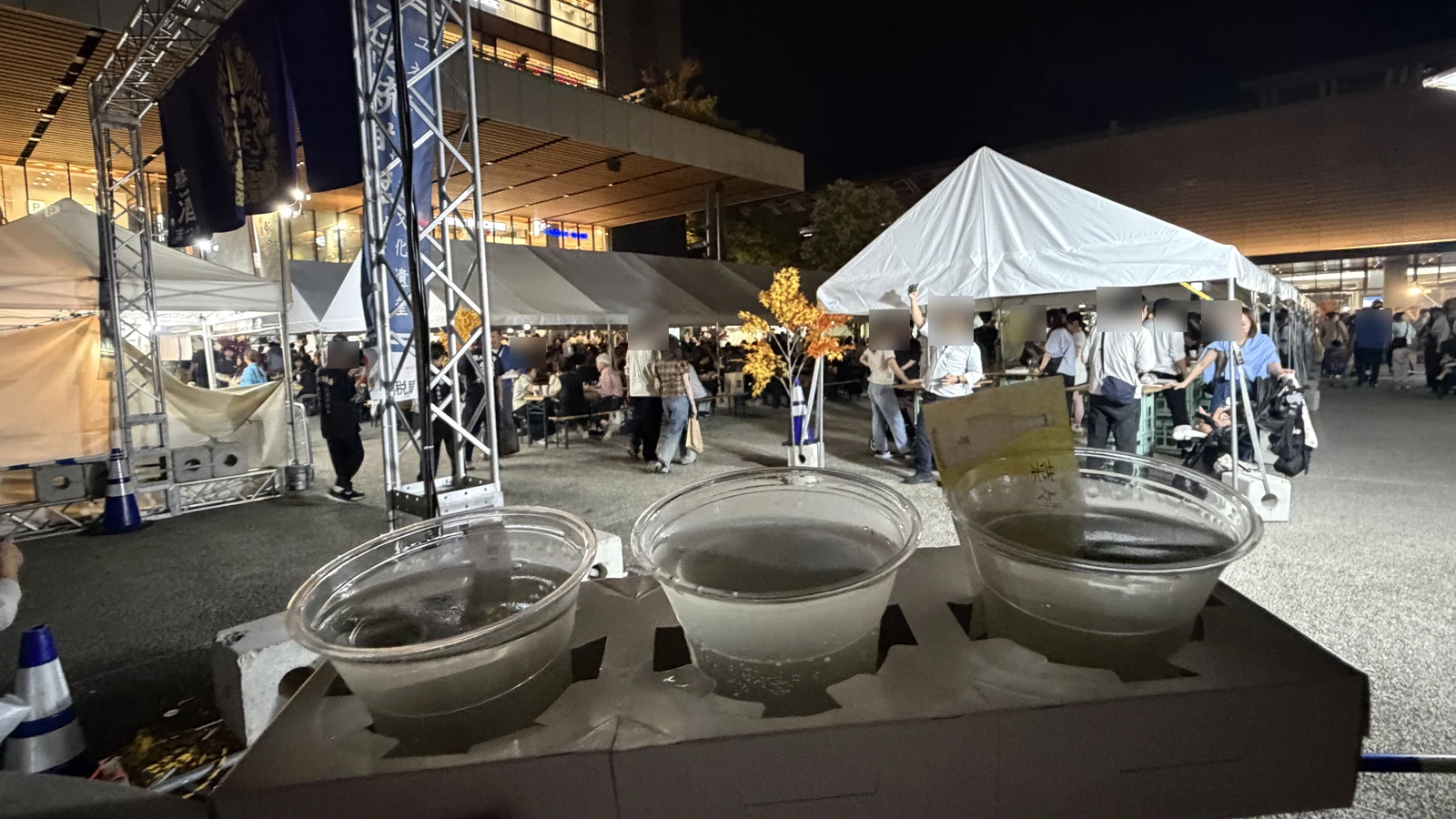
Table of Contents
For three days in October 2026, the square in front of JR Kumamoto Station turned into a small sake town.
The Kumamoto Autumn Sake Festival 2026 (熊本秋酒まつり2026) brought seven Kumamoto breweries together for three days, from October 9 to 11. You buy a strip of three tickets, trade each ticket for a small cup of local sake, and find somewhere to sit among food stalls and autumn-colored decorations.
I went twice: once on the afternoon of October 10 to look around, and again around 7:00 PM on October 11 to taste. This is what I drank, what the festival felt like, and what I would tell a friend visiting next year.
This article covers the 2026 festival. Dates, breweries, prices, and ticket rules may change in future years.
What the Kumamoto Autumn Sake Festival is
The festival is held at AMU Hiroba, the open plaza in front of AMU Plaza Kumamoto, on the Shirakawa exit side of JR Kumamoto Station. It is organized by JR Kumamoto City, with the cooperation of the Kumamoto Sake Brewers Association and JR Kyushu Shoji.
The seven breweries in 2026 were all from Kumamoto Prefecture:
- Chiyonosono (千代の園) — Yamaga
- Koro (香露) — the Kumamoto Prefectural Sake Research Institute, Kumamoto City
- Zuiyo (瑞鷹) — Kawashiri, Kumamoto City
- Tsujun (通潤)
- Kameman (亀萬)
- Yamamura Shuzo (山村酒造), maker of Reizan (れいざん)
- Kawazu Shuzo (河津酒造), maker of Shichihoda (七歩蛇)
Each brewery had its own booth, with a few sakes on offer and a sign showing how many tickets each one cost.
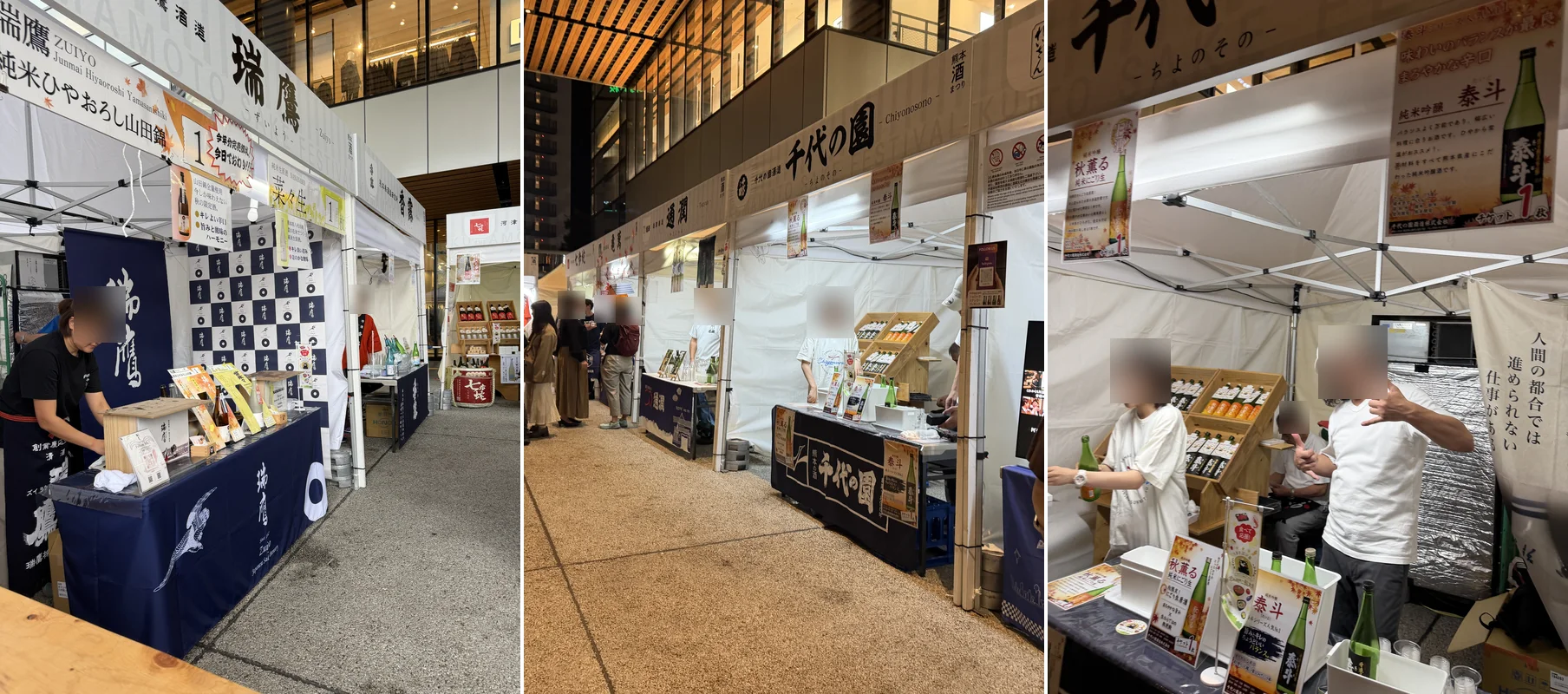
Left: Zuiyo’s booth on the afternoon of October 10, with Koro’s booth next door. Center: the row of brewery booths around 7:00 PM on October 11, including Tsujun and Chiyonosono. Right: Chiyonosono’s booth, with signs for Akikaoru and Taito.
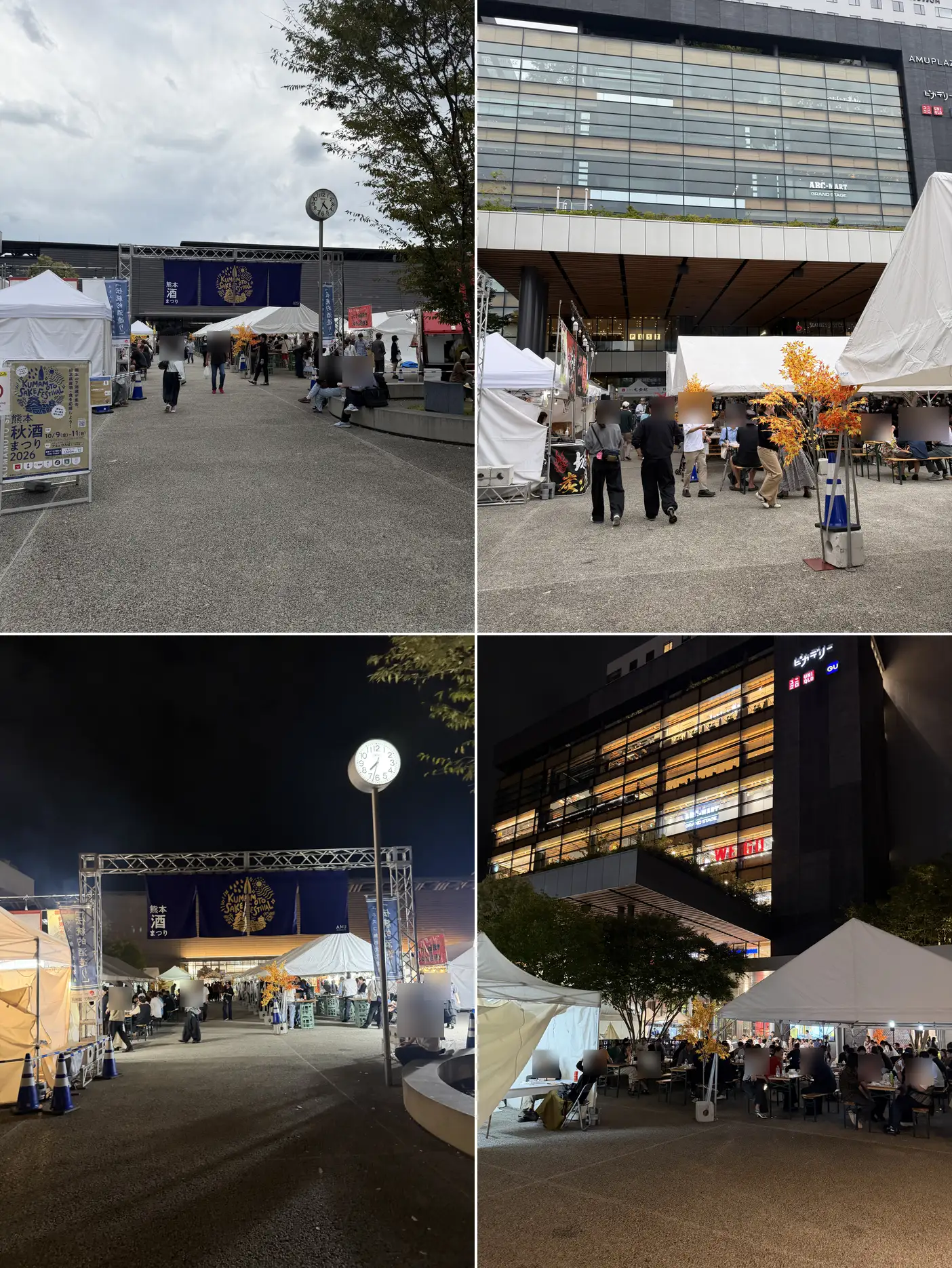
Top: the entrance and the plaza on the afternoon of October 10. Bottom: the same entrance and the seating area around 7:00 PM on October 11, when the plaza was at its busiest.
How the tickets work
The system is simple, and there was an English guide board by the entrance:
- Buy a ticket set at the ticket booth. One set is three tickets for ¥1,500, tax included.
- Visit the brewery booths and choose three sakes.
- Trade one ticket for one cup. Each pour is 90 ml. A few premium sakes cost two tickets per cup.
- Find a seat and enjoy.
Tickets are only for sake. Food and beer are paid for directly at each food stall, and you cannot bring outside food or drinks into the venue. According to the printed ticket, part of the ticket proceeds goes to areas affected by the 2026 Kumamoto earthquake.
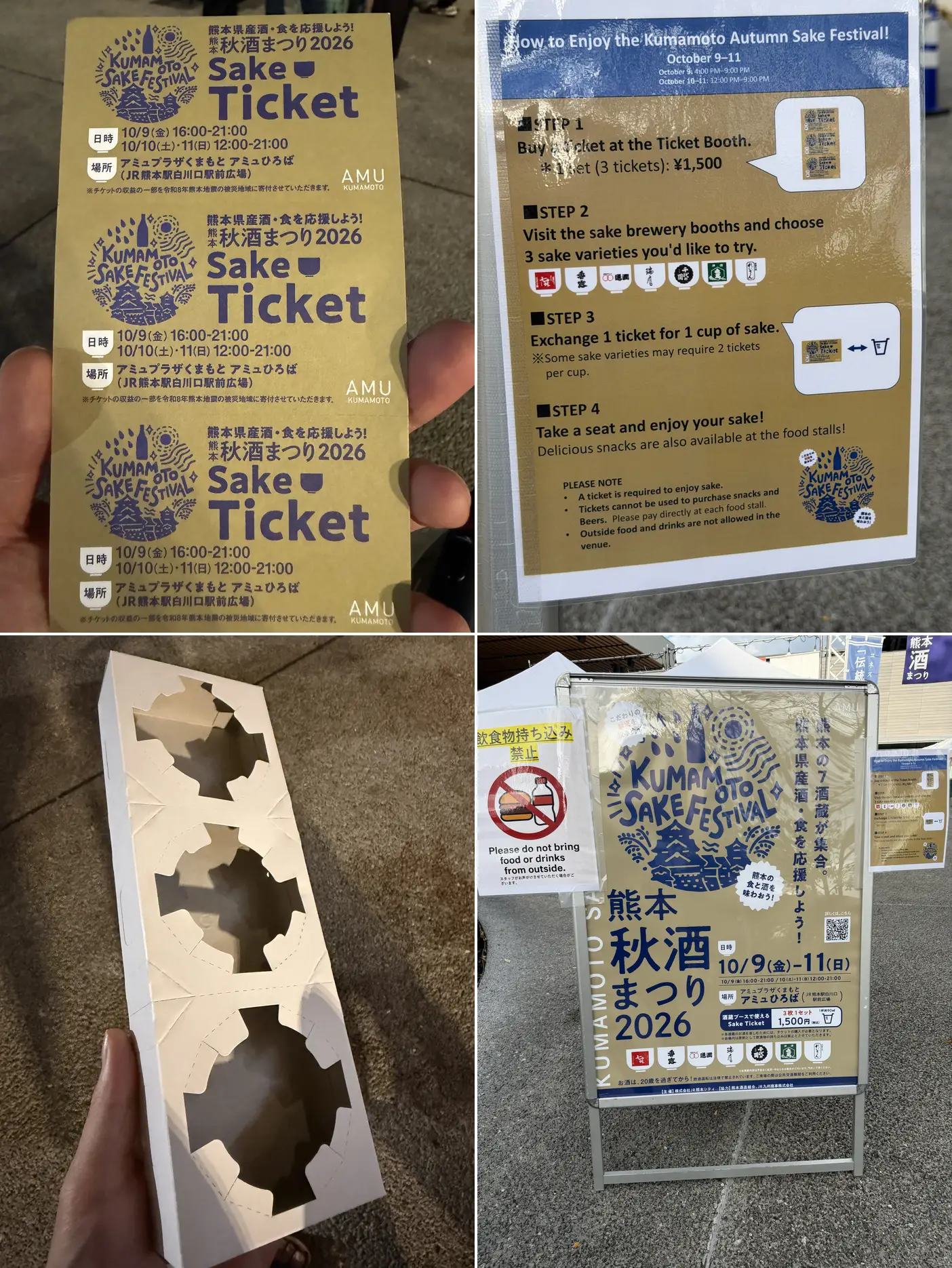
Clockwise from top left: the three-ticket strip, the English “How to Enjoy” board, the festival poster with the seven brewery marks, and the cardboard holder that keeps three cups steady while you walk.
The cardboard holder is a small but thoughtful detail. With three plastic cups in hand, it is surprisingly easy to spill one while looking for a seat. The holder turns them into a little tasting flight you can carry with one hand.
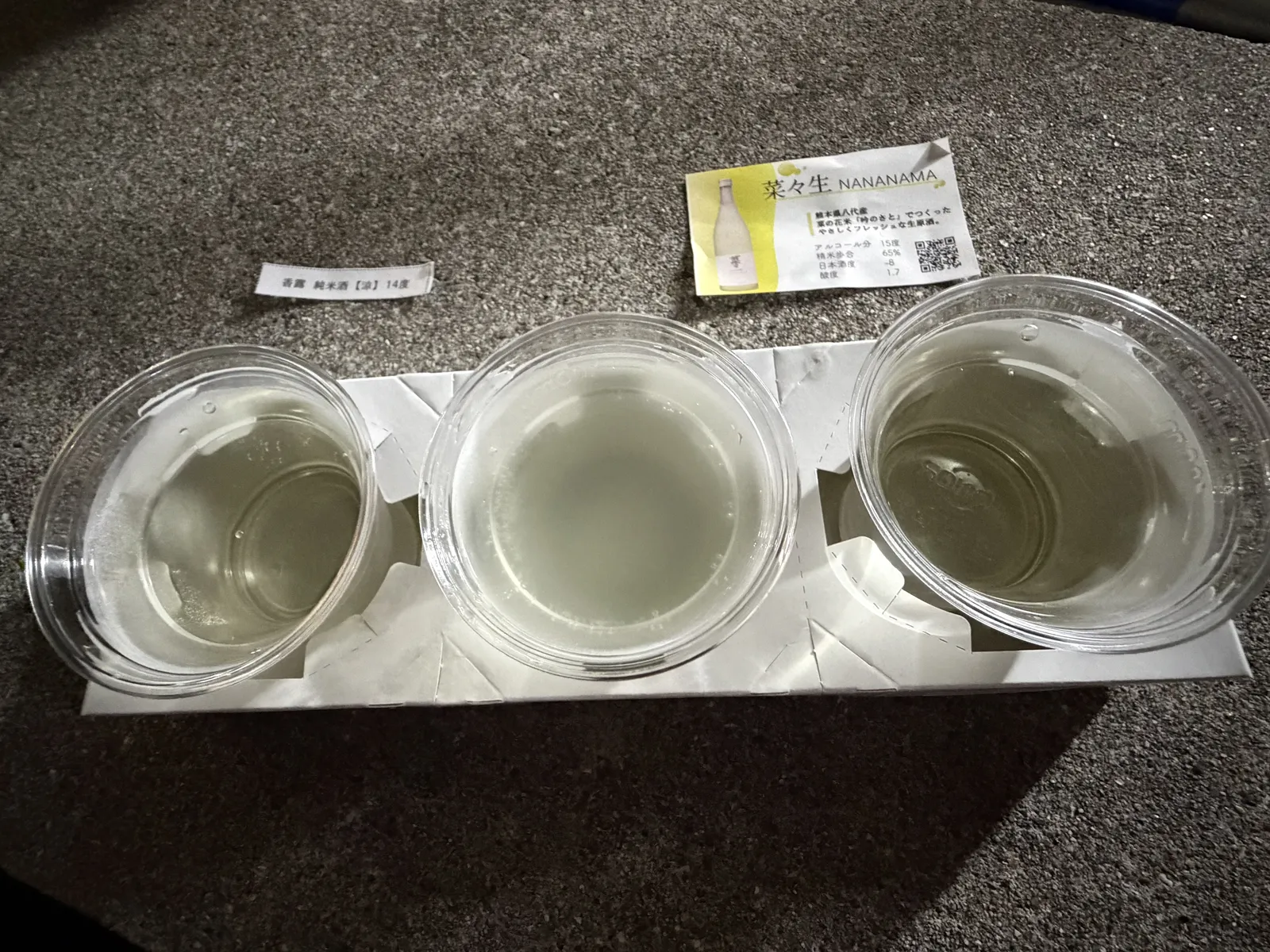
My three cups, from left: Koro Ryo, Chiyonosono Akikaoru, and Zuiyo Nananama. The middle one is visibly cloudier.
The three sakes I tasted
These are brief festival impressions rather than full bottle reviews: all three were tasted from plastic cups in a busy outdoor setting.
Chiyonosono “Akikaoru” Junmai Nigori Nama (秋薫る)
Chiyonosono Shuzo, Yamaga, Kumamoto. Est. 1896.
Akikaoru — roughly “autumn fragrance” — is an autumn-only junmai ginjo nigori, sold as an unpasteurized, undiluted nama genshu. The booth sign summed it up as “mellow umami × the gentle fizz that only nama sake has.”
- Alcohol: 17%
- Rice polishing ratio: 55%
- Type: junmai ginjo, nigori nama genshu, autumn limited
In the cup, it was lightly cloudy. The first impression was acidity and umami, followed by sweetness and a clean bitterness. It felt fresh, but with real weight behind it — umami, bitterness, and body all at once — and there was a faint prickle of carbonation on the tongue.
Of the three, this was the one with the most going on. I would happily drink it again.
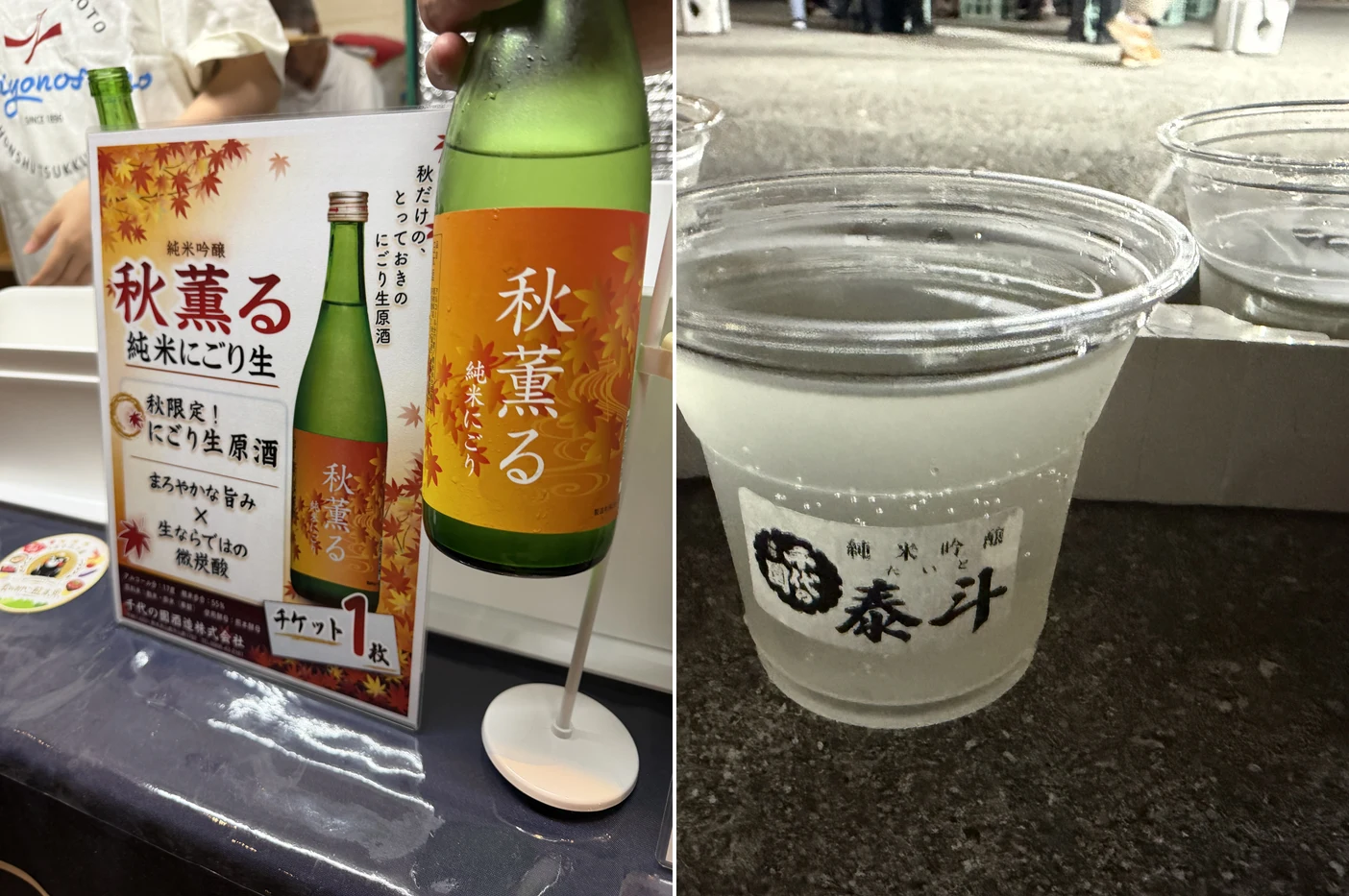
Left: the Akikaoru display card and bottle. Right: my cup of Akikaoru, which carried a sticker for Taito (泰斗), another Chiyonosono junmai ginjo.
Koro “Ryo” Junmai (香露 涼)
Kumamoto Prefectural Sake Research Institute, Kumamoto City.
The Kumamoto Prefectural Sake Research Institute is an unusual brewery. Its origins date to 1909, when the research institute was established to improve the quality of sake in Kumamoto; the present company was established in 1918. It still maintains the original strain of Kumamoto yeast — the yeast known nationally as Kyokai No. 9. The Ryo label itself carries the words 熊本酵母発祥蔵 — “the brewery where Kumamoto yeast was born.” The staff told me Ryo is made with No. 9 yeast.
- Alcohol: 14%
- Rice polishing ratio: 65%
- Type: junmai
- Bottle price at the booth: ¥1,700 (tax included)
The booth described Ryo as “a lightly sweet, easy-drinking junmai for summer,” best served well chilled. Ryo means “cool,” and it is really a summer sake that was still being poured in October.
It tasted exactly that way: fresh, with little bitterness, and very easy to drink. Of the three, this was clearly the cleanest and lightest — it felt designed to slip down smoothly. I would drink it again.
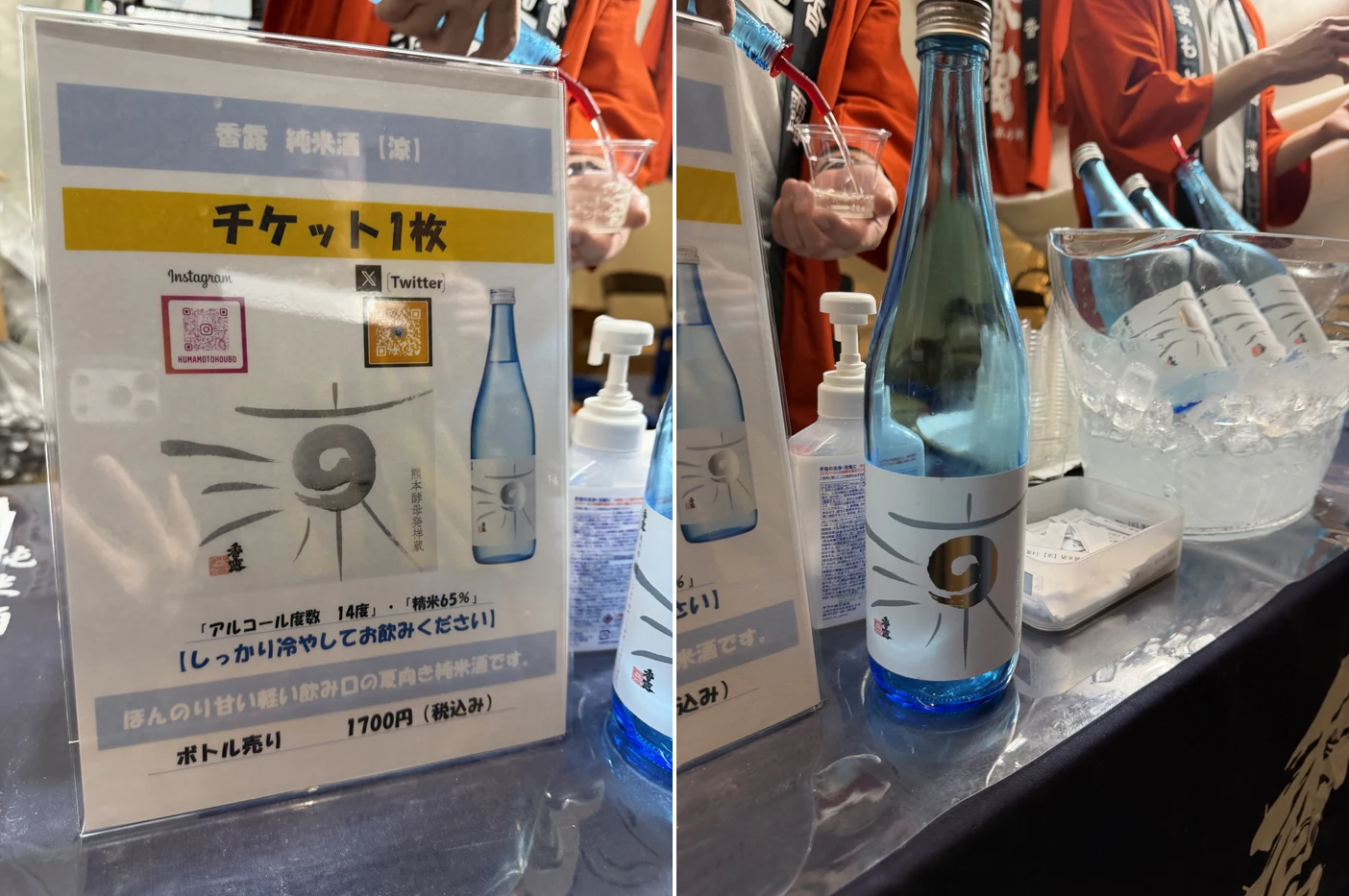
Left: the Ryo display card — one ticket, 14% alcohol, 65% polishing, “serve well chilled.” Right: the bottle on the counter, with more bottles on ice behind it.
Zuiyo “Nananama” Junmai Nama Genshu (瑞鷹 菜々生)
Zuiyo, Kawashiri, Kumamoto City. Est. 1867.
Nananama is a junmai nama genshu brewed with nanohana-mai — Gin no Sato rice grown with a rapeseed-flower (nanohana) method in Yatsushiro, Kumamoto, according to the booth sign. The label also lists KA-4 yeast and the English tagline “Natural Sweet.”
- Alcohol: 15%
- Rice polishing ratio: 65%
- Sake Meter Value: −8
- Acidity: 1.7
- Award: Gold, Fine Sake Awards Japan 2026 — Nama Sake category (ワイングラスでおいしい日本酒アワード 生酒部門)
- Bottle price at the festival sales table: ¥1,800 (tax included)
An SMV of −8 points to a sweet sake, and it showed: this was the sweetest of the three. But there was a little bitterness under the sweetness, and the texture felt slightly thick and smooth. What kept it from becoming heavy was the finish — a touch of dryness and spice at the end gave it a clean cut.
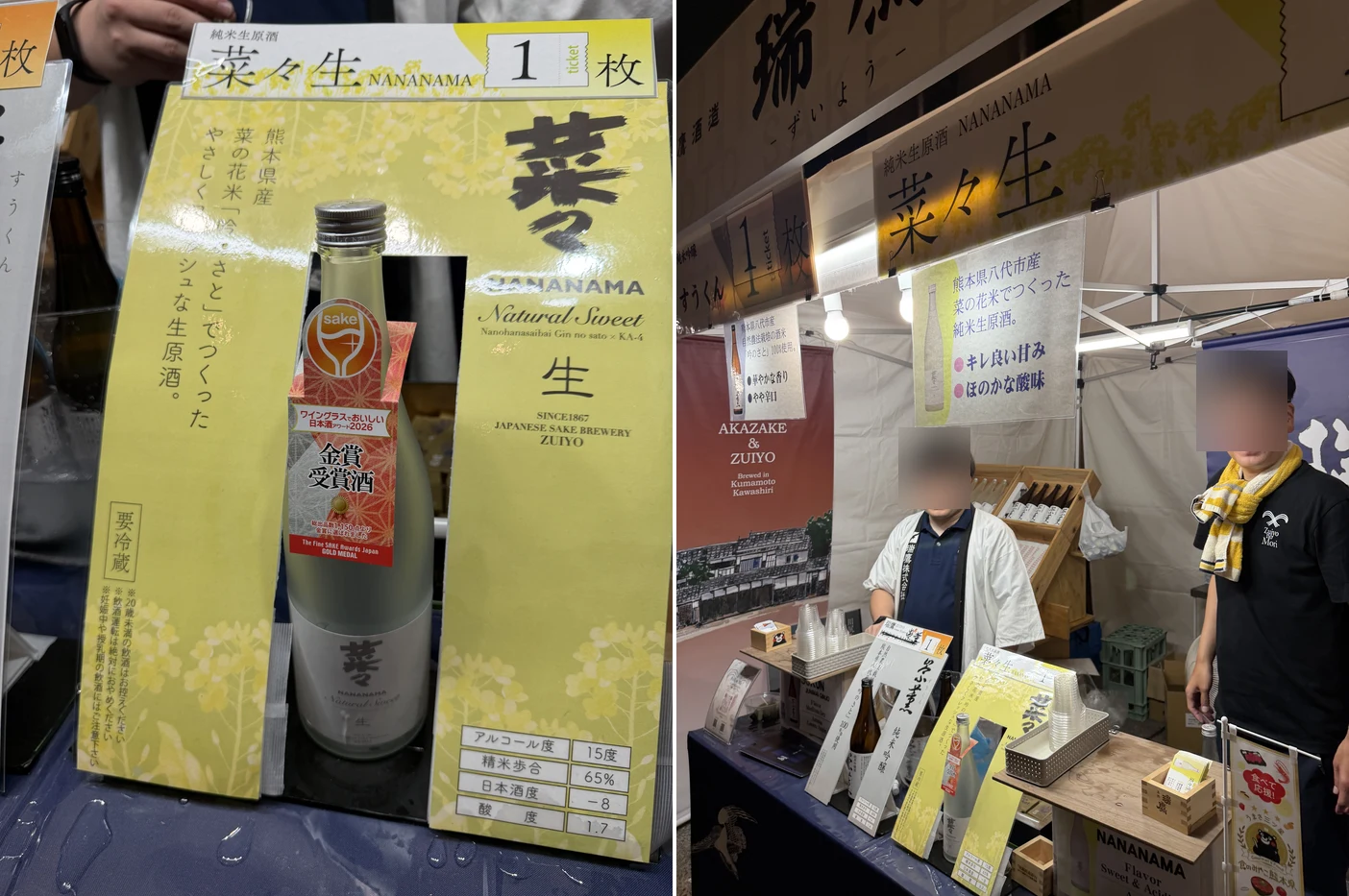
Left: the Nananama card, with the Fine Sake Awards Japan 2026 gold tag. Right: the Zuiyo booth at night. The sign above reads “pure rice nama genshu made with nanohana rice from Yatsushiro, Kumamoto — clean sweetness, gentle acidity.”
How the three compared
| Koro Ryo | Chiyonosono Akikaoru | Zuiyo Nananama | |
|---|---|---|---|
| Style | Junmai | Junmai ginjo nigori nama genshu | Junmai nama genshu |
| Alcohol | 14% | 17% | 15% |
| My impression | Lightest and cleanest | Most layered: acidity, umami, bitterness, faint fizz | Sweetest, slightly thick, dry spicy finish |
| Choose it if… | You want something refreshing | You want the most complex cup | You like sweeter sake with a clean ending |
I would happily drink both Ryo and Akikaoru again. Nananama was the sweetest of the three, but its dry finish kept it from feeling heavy.
Food stalls and buying bottles
Around the brewery booths, the plaza was ringed with food stalls: takoyaki, grilled chicken skin, Hakata-style horumon, grilled sweetfish (ayu) from Hitoyoshi, eel, and more. Food is paid for separately at each stall.
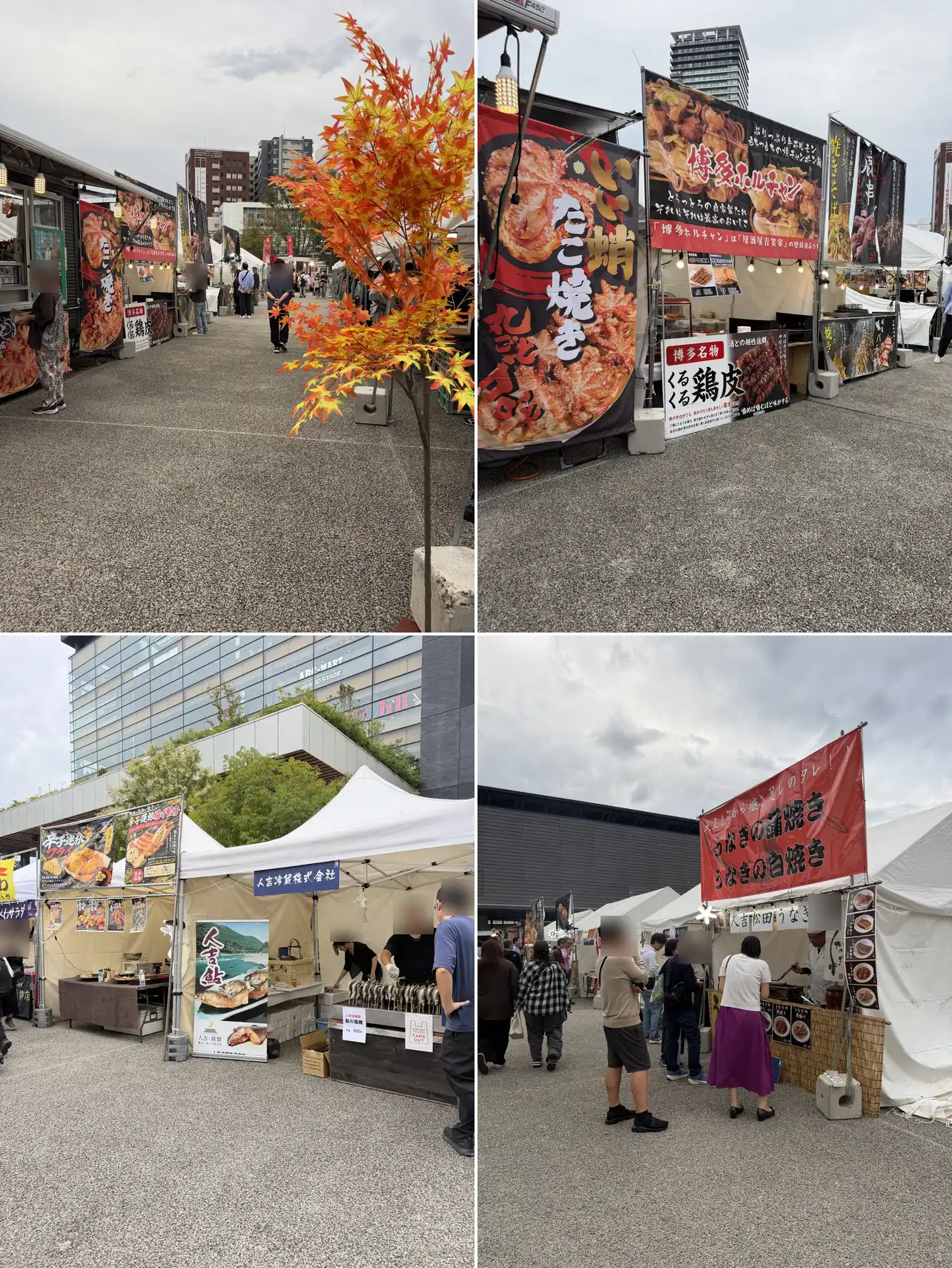
Food stalls on the afternoon of October 10. Tickets cannot be used here — each stall takes payment directly.
There was also a sales table run by the Kumamoto Sake Brewers Association, where you could buy full bottles of the festival sakes to take home. Each bottle had a price tag, so it was easy to buy the one you liked after tasting.
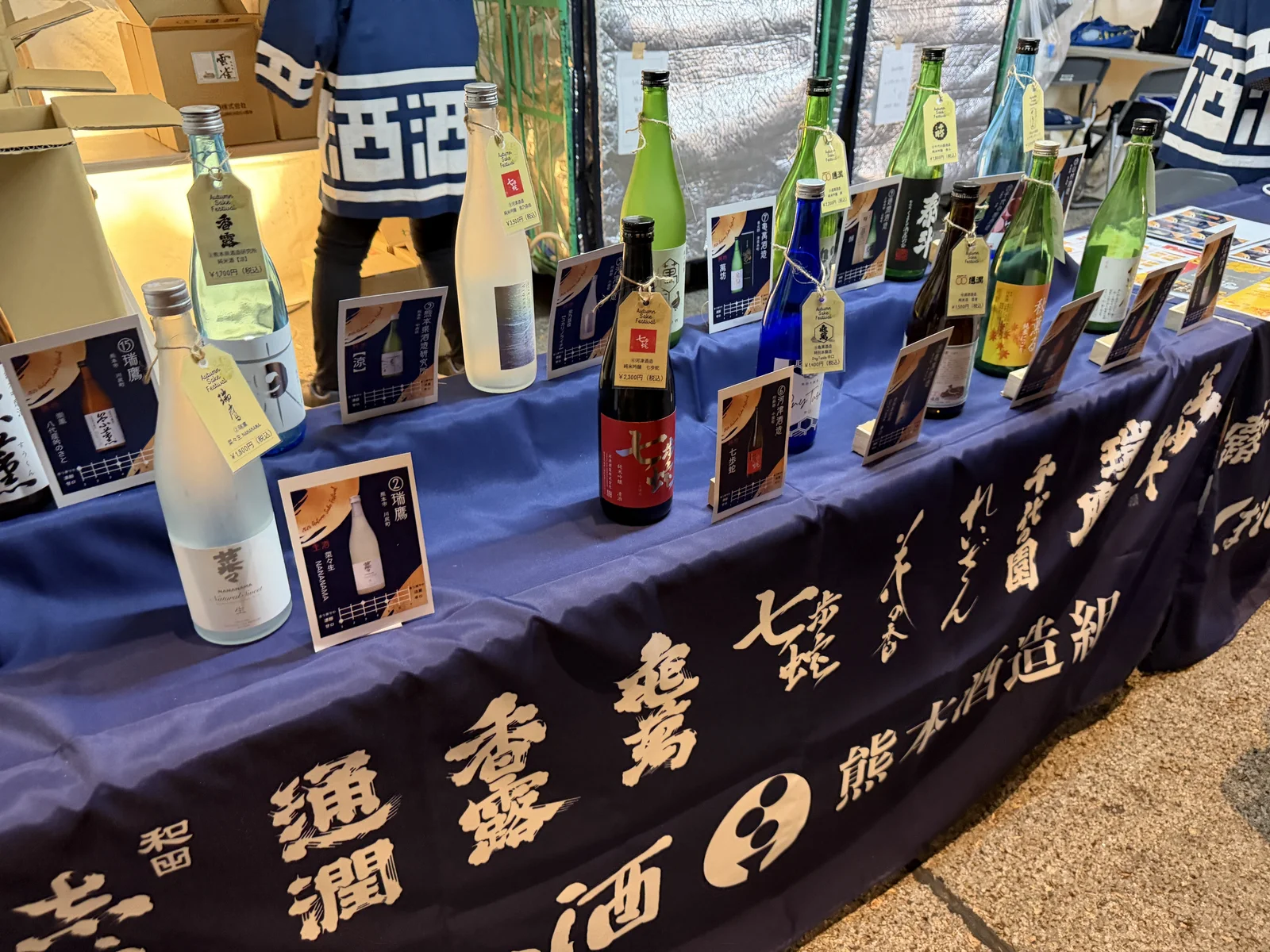
Bottles from the participating breweries, including Ryo (¥1,700) and Nananama (¥1,800). The tablecloth lists the brewery names.
If you miss the festival, the staff told me that some of these sakes are also sometimes stocked at two shops near the venue: Ushijima Saketen (うしじま酒店), inside Kumamoto Station, and Tokunaga Saketen (徳永酒店), just across the road in front of the station. Stock changes, so treat that as a lead rather than a guarantee.
Where in Japan
Kumamoto sits in the middle of Kyushu, Japan’s southern main island — about 35–50 minutes from Hakata Station by shinkansen, depending on the train, and reachable by limousine bus from Kumamoto Airport.
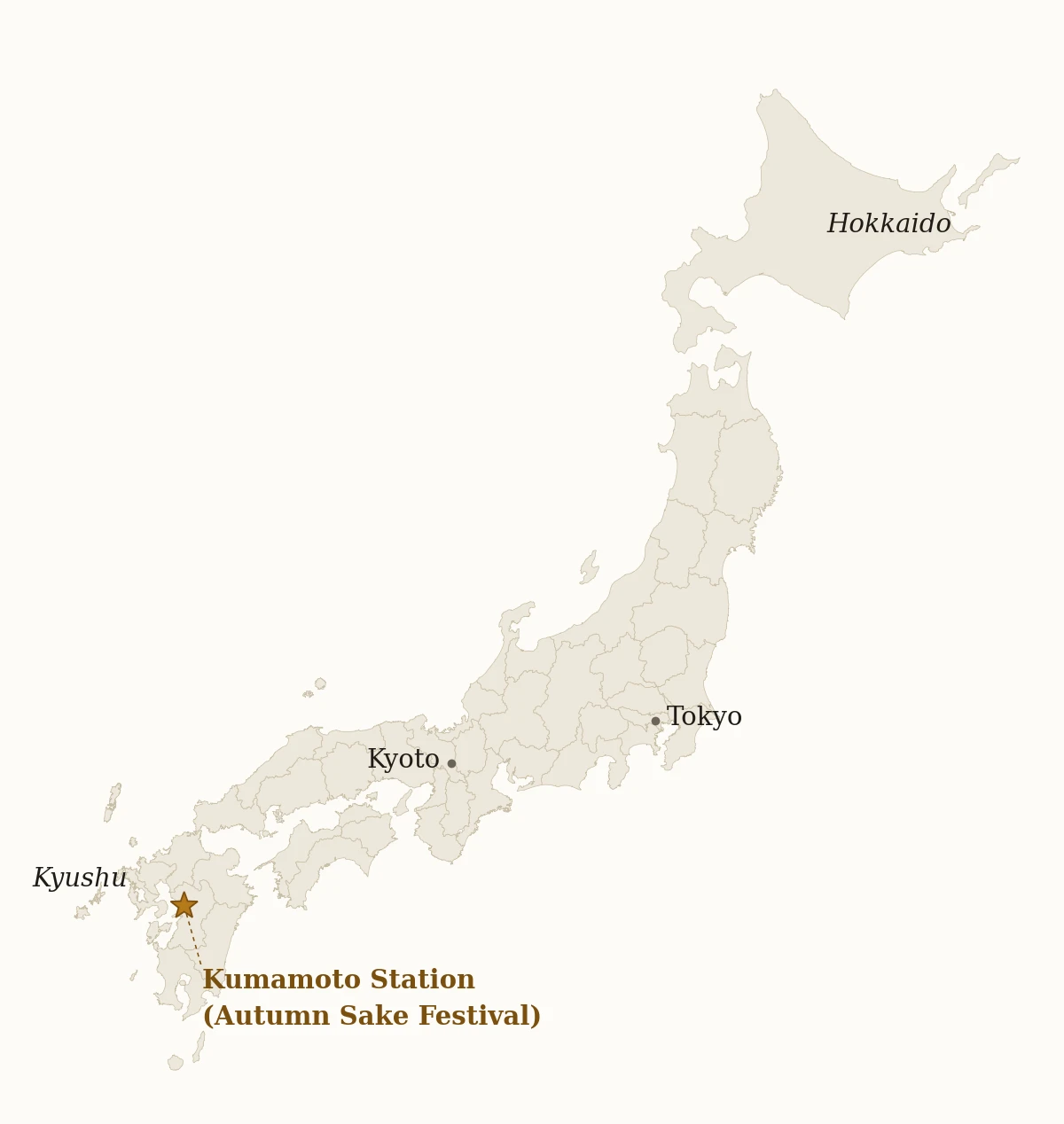
Where in Japan: The festival was held at the plaza in front of JR Kumamoto Station, in the center of Kyushu.
The three breweries behind my cups are all close to the station. Koro’s brewery in Shimazaki is only about two kilometers away — so close that the two stars almost overlap on the map below. Zuiyo’s is in the historic town of Kawashiri just to the south, and Chiyonosono is in the hot-spring town of Yamaga to the north. If you are coming from Fukuoka, the whole area is an easy day trip from Hakata.
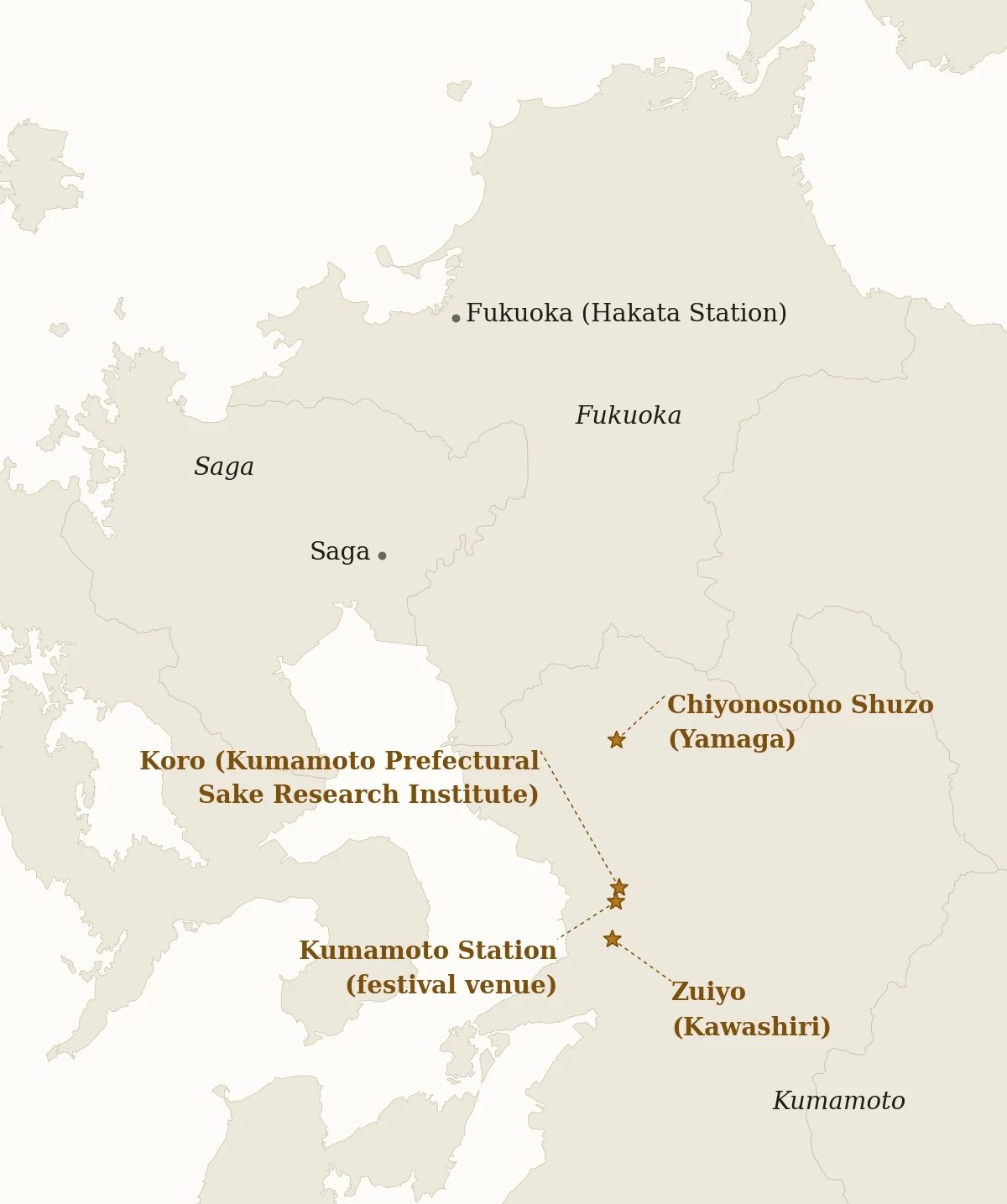
Where in Japan: Kumamoto Station (the festival venue), the Kumamoto Prefectural Sake Research Institute (Koro) in Shimazaki, Zuiyo in Kawashiri, and Chiyonosono Shuzo in Yamaga — with Fukuoka (Hakata Station) and Saga to the north for reference.
Practical tips for visiting
When: In 2026, the festival ran on October 9 from 4:00 PM to 9:00 PM, and on October 10–11 from noon to 9:00 PM. Check the dates for next year before you plan.
Crowds: On the afternoon of October 10, the plaza was lively but relaxed. Around 7:00 PM on October 11 — the last evening — it was much busier.
Seating: Inside the venue, you need to look for an empty seat at the long tables, which takes a little patience in the evening. But the station plaza has benches just outside the festival area, and plenty of people were sitting there with their cups and food. If the tables are full, that is an easy fallback.
Budget: ¥1,500 gets you three 90 ml cups — about 270 ml of sake in total. Food is extra.
Language: The ticket system works without Japanese, thanks to the English guide board by the entrance. The booth signs are mostly in Japanese, so pointing at a display card works fine.
One honest downside: In the evening rush, it is hard to taste slowly. The cups are plastic, the tables are shared, and the noise level rises as the night goes on. It is a festival, not a tasting room — go for the atmosphere and the chance to compare local sakes side by side, and buy a bottle of your favorite to enjoy properly at home.
Why this matters for this blog
Sake festivals like this are one of the easiest ways to meet a region’s breweries in one place. In a single evening at Kumamoto Station, I tasted a research institute’s summer junmai made with the yeast it gave to the whole country, an autumn-only nigori from a hot-spring town, and a sweet nama genshu made with rice from Yatsushiro.
None of them required a trip to a brewery. They were waiting in front of the station, three cups at a time.
Kanpai — to the breweries that come to meet you.
Related Reading
- Senkin Modern Review — a Tochigi sake brewed with Kumamoto’s heirloom Homashi rice, bought in Kumamoto City
- Four Kyushu Sakes in a Wooden Masu — another easy station tasting, at Hakata Station in Fukuoka
- Muroka, Nama, and Genshu Explained — what “nama genshu” on these labels means
- What Does +14 Mean on a Sake Label? — how to read a Sake Meter Value like Nananama’s −8
Please enjoy sake responsibly and follow the drinking laws in your country or region.
Sake is an alcoholic beverage. This article is intended for readers of legal drinking age in their country — please drink responsibly.