
Kutani Ware Sakazuki Review|Shogetsu Bird-and-Flower Sake Cup
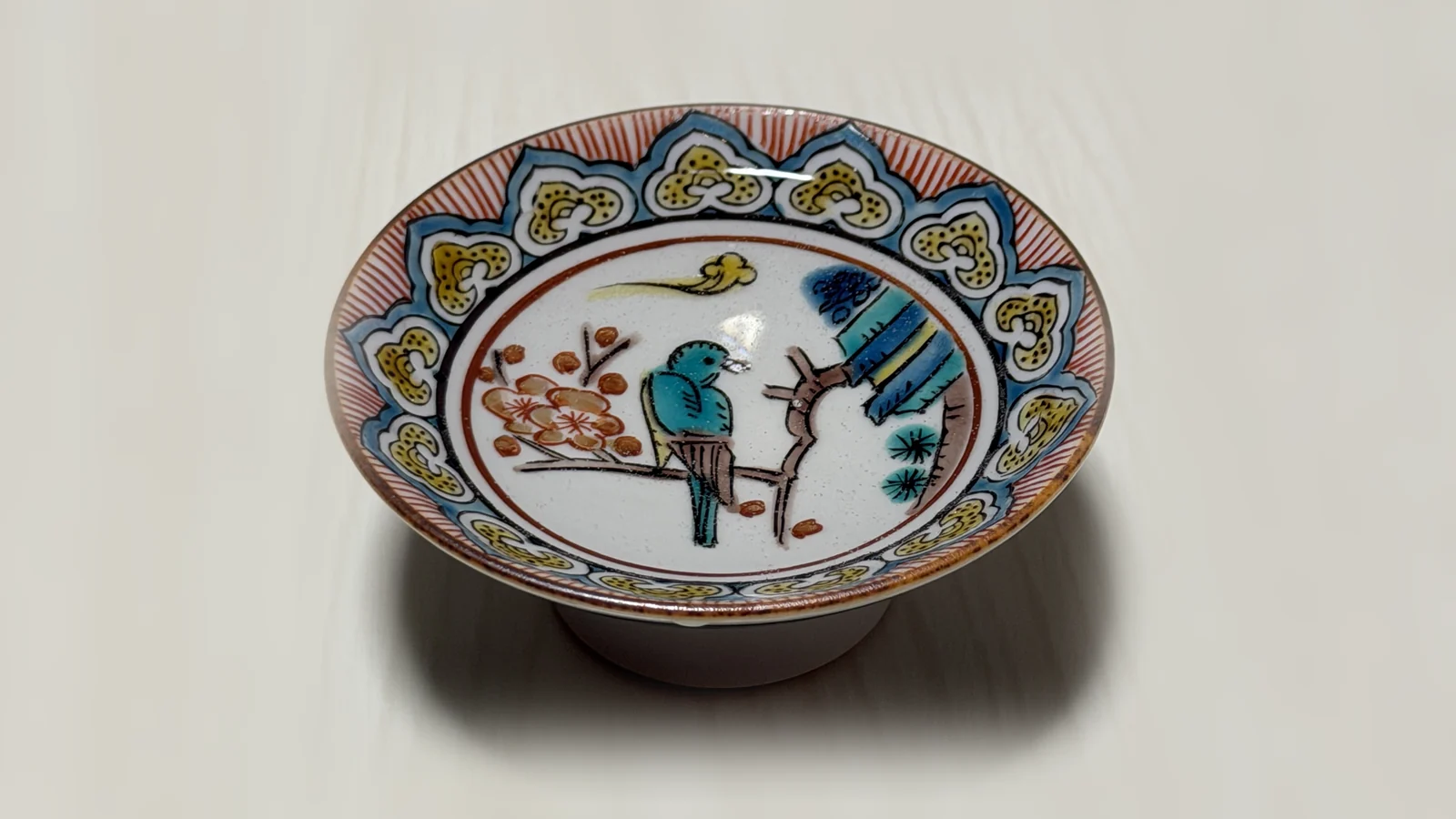
Table of Contents
- At a Glance
- Kutani Ware in Brief
- The Cup: Bird, Flowers, and a Hidden Underside
- Finding the Cup at Kutani Hyakumangoku
- Drinking Senkin Modern from a Shallow Sakazuki
- Sakazuki vs. Guinomi: Does the Shape Change the Drinking Experience?
- Kutani, Oribe, and Bizen Side by Side
- Practical Notes and Care
- Final Thoughts: Was It Worth ¥9,000?
- Related Reading
At the West Japan Ceramics Fair in Kokura, I bought three very different sake vessels: a rustic Bizen guinomi, a deep green Oribe guinomi, and this colorful Kutani ware sakazuki.
The Kutani cup was the most expensive of the three. What drew me in was the painting — a small turquoise bird among flowering branches, framed by a border of red, yellow, and blue-green. What surprised me came later, at home: the wide, shallow shape made sake feel noticeably different from my usual guinomi.
At a Glance
| Detail | Information |
|---|---|
| Ceramic tradition | Kutani ware |
| Type | Hira-sakazuki (平盃, flat sake cup) |
| Design | Bird and flower (花鳥, kacho) |
| Inscription | Shogetsu (祥月) — signed on the wooden box and marked on the base as “Kutani Shogetsu” |
| Region | Ishikawa Prefecture, Japan |
| Purchased at | West Japan Ceramics Fair, Kokura |
| Seller | Kutani Hyakumangoku (Booth No. 113) |
| Displayed price | ¥11,000 (tax included) |
| Price paid | ¥9,000 |
| Diameter | About 8 cm (3.1 in) |
| Height | About 3.2 cm (1.3 in) |
| Capacity | Approx. 40 ml to the brim; around 30 ml for practical use |
| Sake used | Senkin Modern |
Kutani Ware in Brief
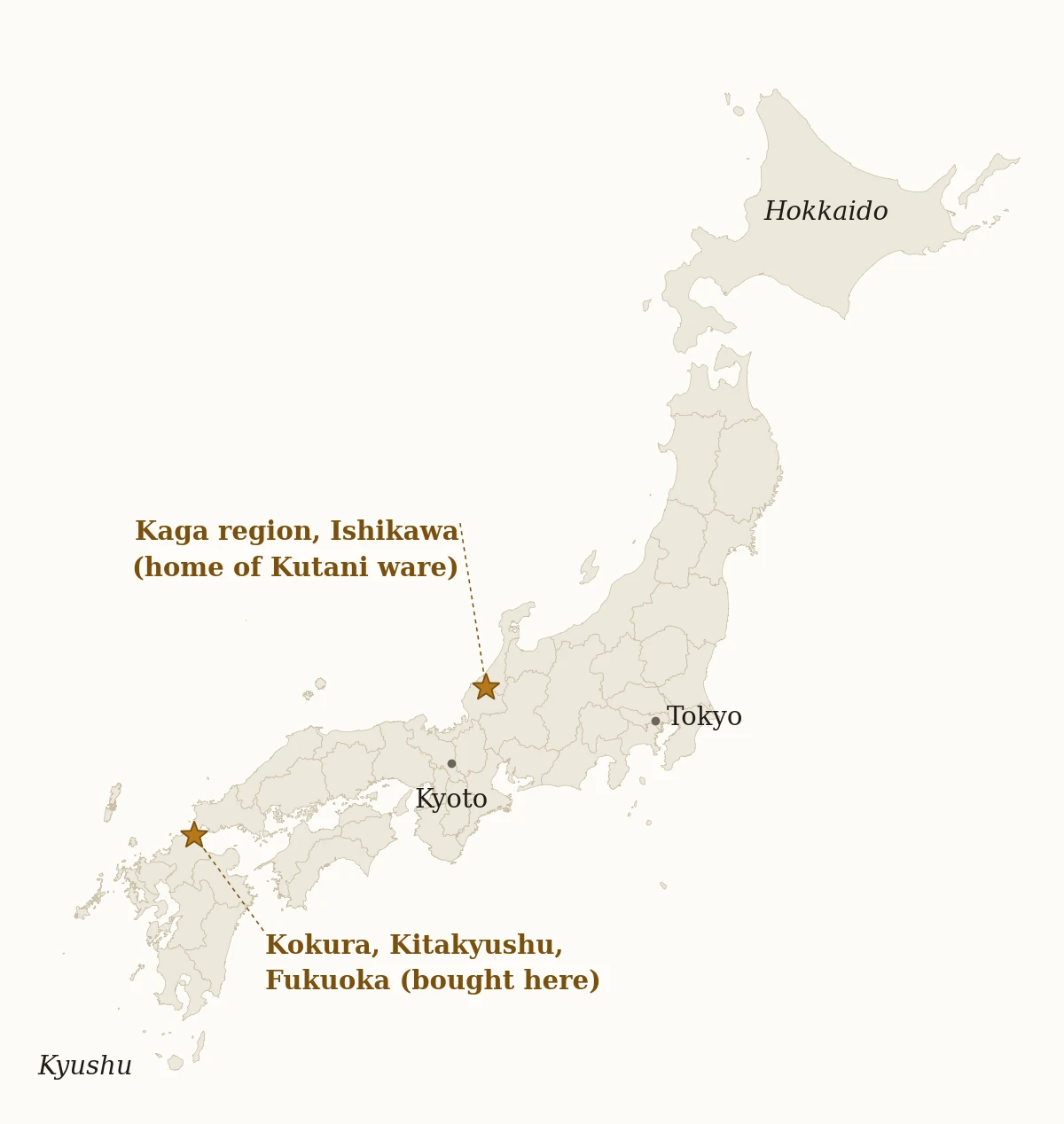
Kutani ware comes from the Kaga region of present-day Ishikawa Prefecture, on the Sea of Japan coast. The name refers to Kutani, a village in what is now Kaga City.
The tradition is usually traced to around 1655. According to the leaflet that came with my cup, the early kilns — now called Ko-Kutani, or Old Kutani — were established after porcelain stone was found near Kutani, and a retainer named Goto Saijiro was sent to Arita in Kyushu to learn the techniques. Ko-Kutani is known for bold compositions and rich colors, but the kilns closed suddenly around 1700, for reasons that remain unclear.
Roughly a century later, in the early 19th century, Kutani ware was revived, and several kilns developed their own decorative styles. One of them is akae saibyo, painting with extremely fine red lines, which I came to appreciate at the fair (more on that below).
What unites these styles is colorful overglaze painting: designs painted onto an already-fired, glazed surface and fixed with a further firing. The five traditional colors, Kutani gosai, are red, yellow, green, purple, and dark blue.
That puts Kutani in a very different place from my other two purchases. Bizen expresses clay and fire, Oribe expresses its green glaze — and Kutani puts painting at the center.
The Cup: Bird, Flowers, and a Hidden Underside
The bird-and-flower painting
A turquoise bird perches on a branch beside small reddish blossoms and buds, with blue-green foliage on the other side. The motif belongs to the traditional Japanese category of kacho — birds and flowers. The blossoms remind me of plum, though I have not confirmed which flower is intended.
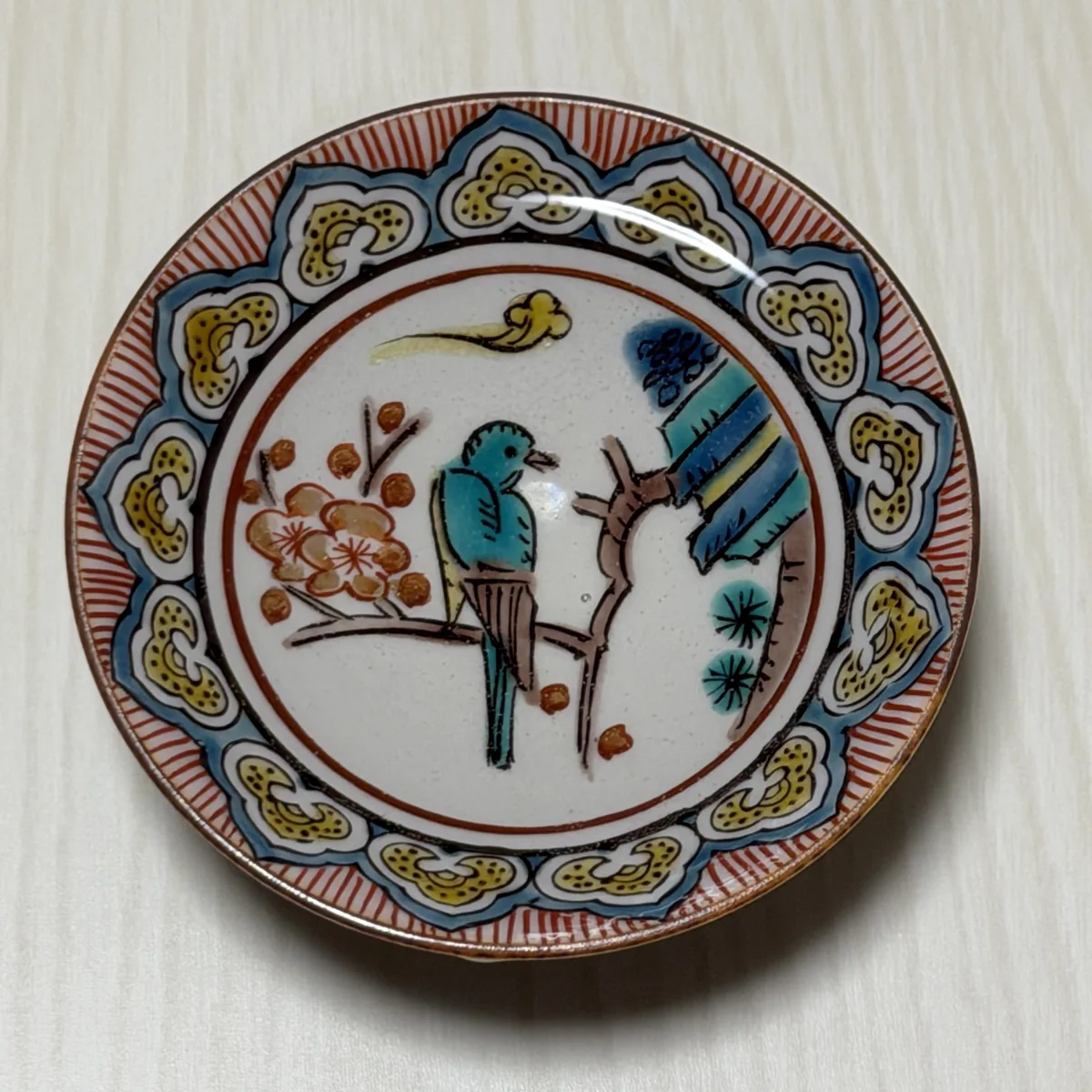
Around the scene runs a border of repeated yellow shapes framed in blue-green, and fine red lines radiate along the outer rim. Despite the number of colors and patterns, the composition feels balanced: the border frames the bird rather than competing with it. My favorite detail is the contrast between the cool turquoise bird and the warm red blossoms — there is something to enjoy even when the cup is empty.
The cup also stands on a raised foot, which lifts the painted bowl above the table.
The turquoise underside
Turn the cup over and the outside of the bowl is covered in vivid turquoise, with dense repeating scroll motifs outlined in black. In the center of the foot is a square turquoise mark reading 九谷 祥月 (Kutani Shogetsu).
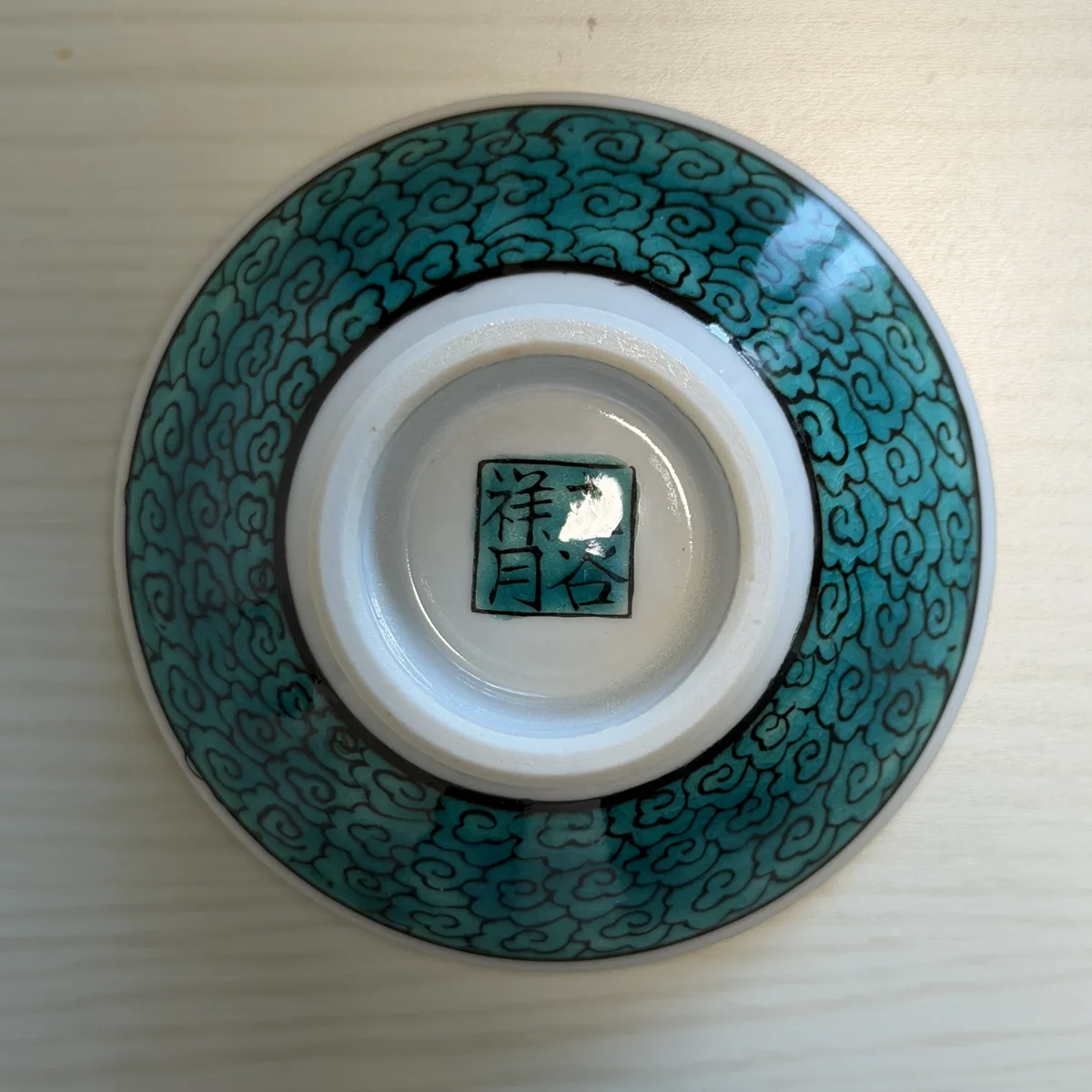
This part stays largely hidden during use, and I would never have noticed it on the display shelf. Finding decoration where you don’t expect it adds to the pleasure of handling the cup.
The wooden box and the Shogetsu name
The cup came in a wooden box. The lid is brushed with the character 盃 (sakazuki) and signed 祥月作 (“made by Shogetsu”), with a red seal. The price tag at the booth also gave the name as the artist’s art name (gō), Shogetsu.
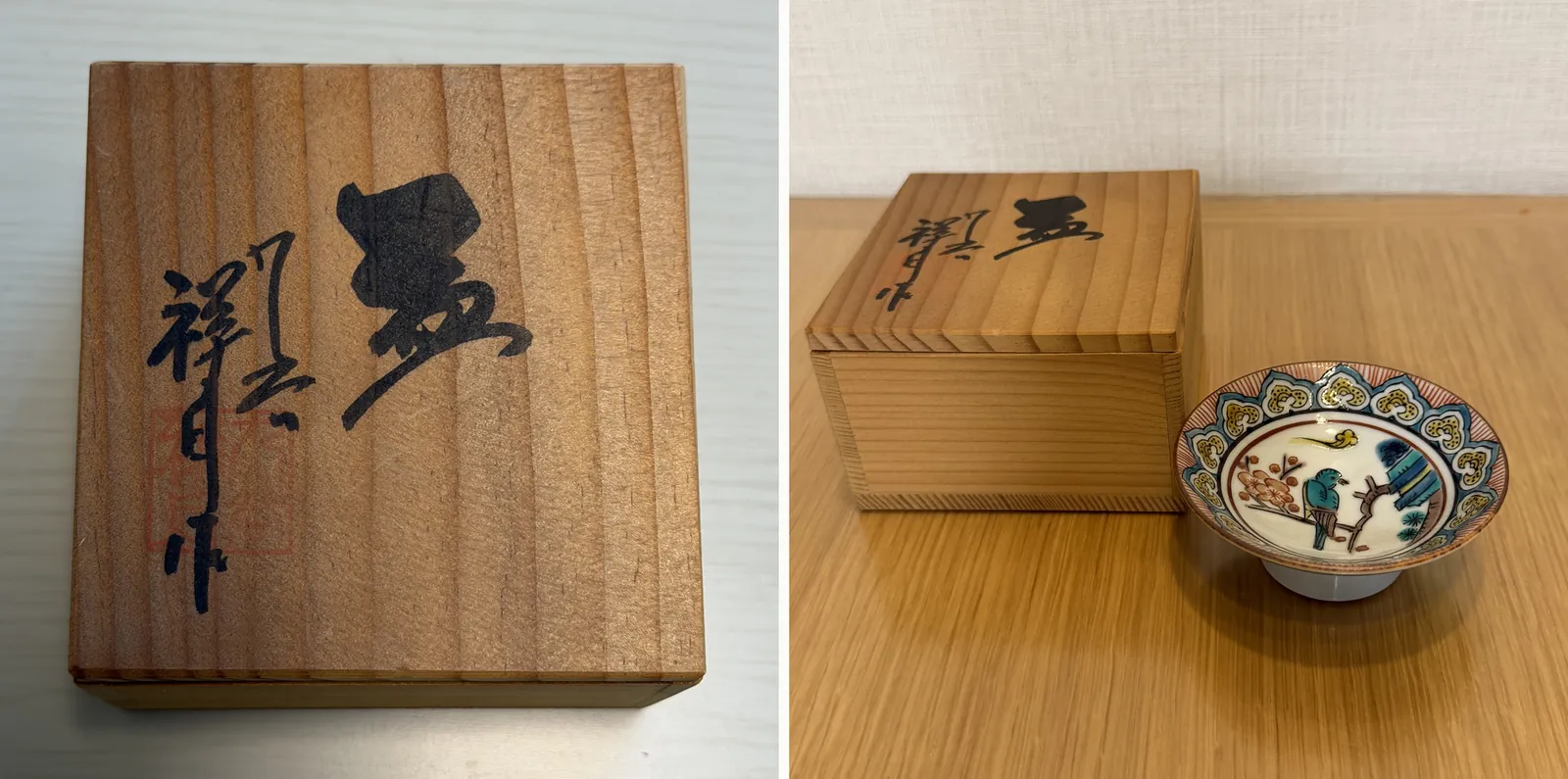
The seller told me the cup was made by an artist rather than mass-produced, but I did not meet the maker and have not confirmed their full name or workshop. So I describe it as a Kutani ware sakazuki bearing the Shogetsu signature, while leaving the maker’s fuller identity unconfirmed. The box also protects the cup and keeps the inscription with it.
Finding the Cup at Kutani Hyakumangoku
Kutani Hyakumangoku is not a single artist’s workshop but a specialist Kutani retailer, carrying work by many different artists. That made the booth especially interesting: I could compare everything from everyday pieces to elaborate works by established artists.
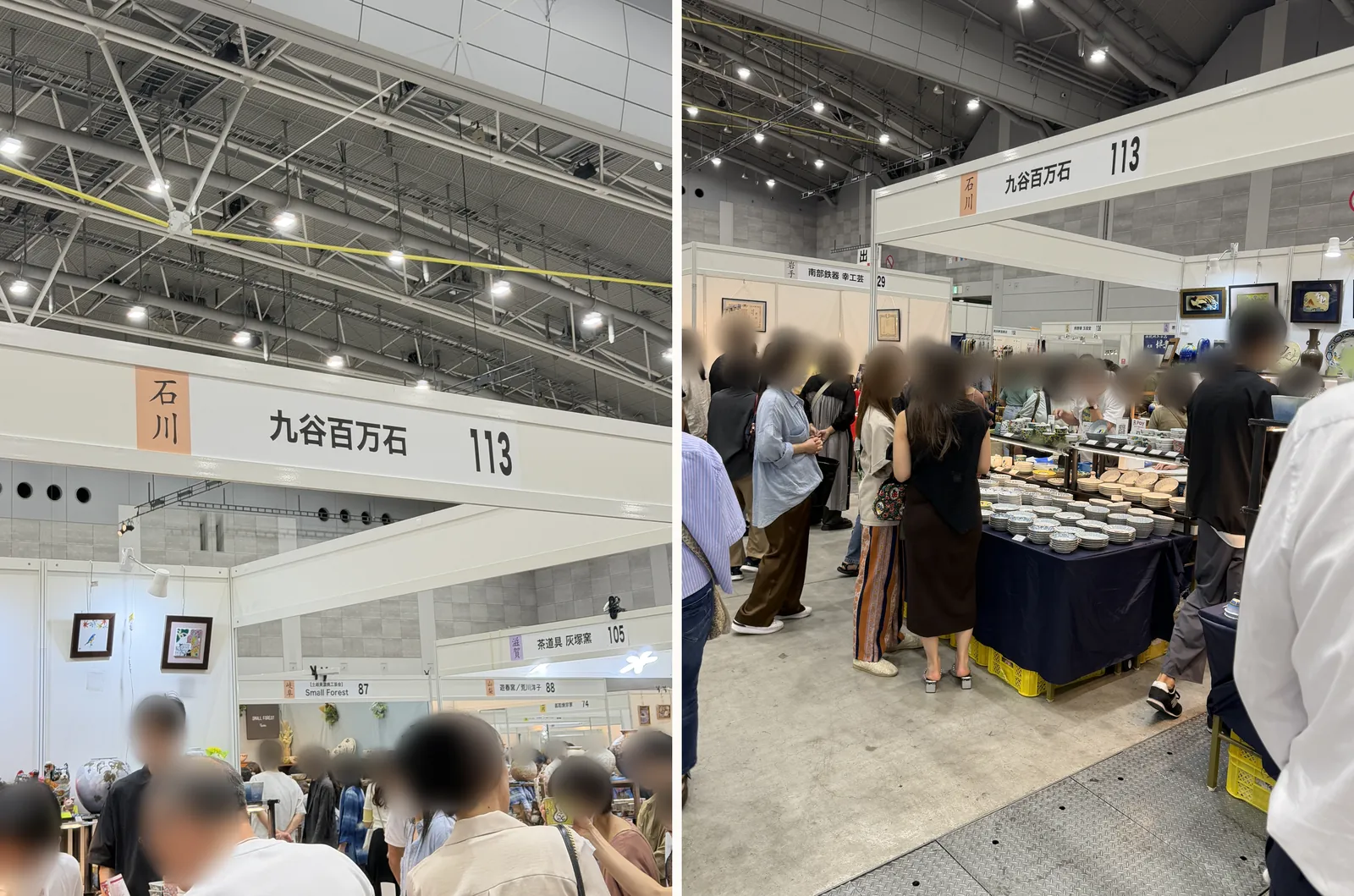
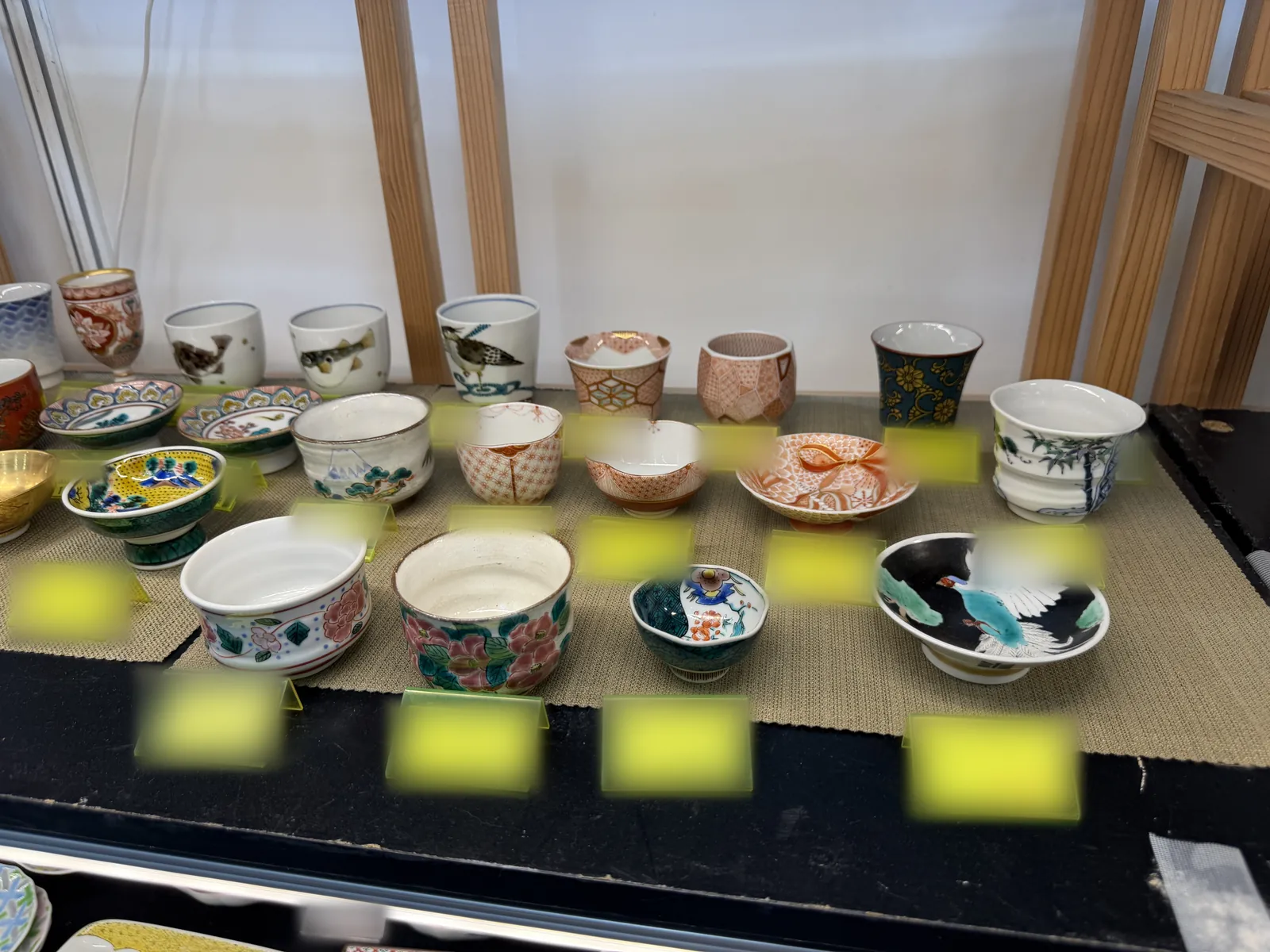
Prices ranged from a few thousand yen to tens of thousands. The shelves toward the back held the most expensive pieces, including intricately painted red-and-white sake vessels by several different artists.
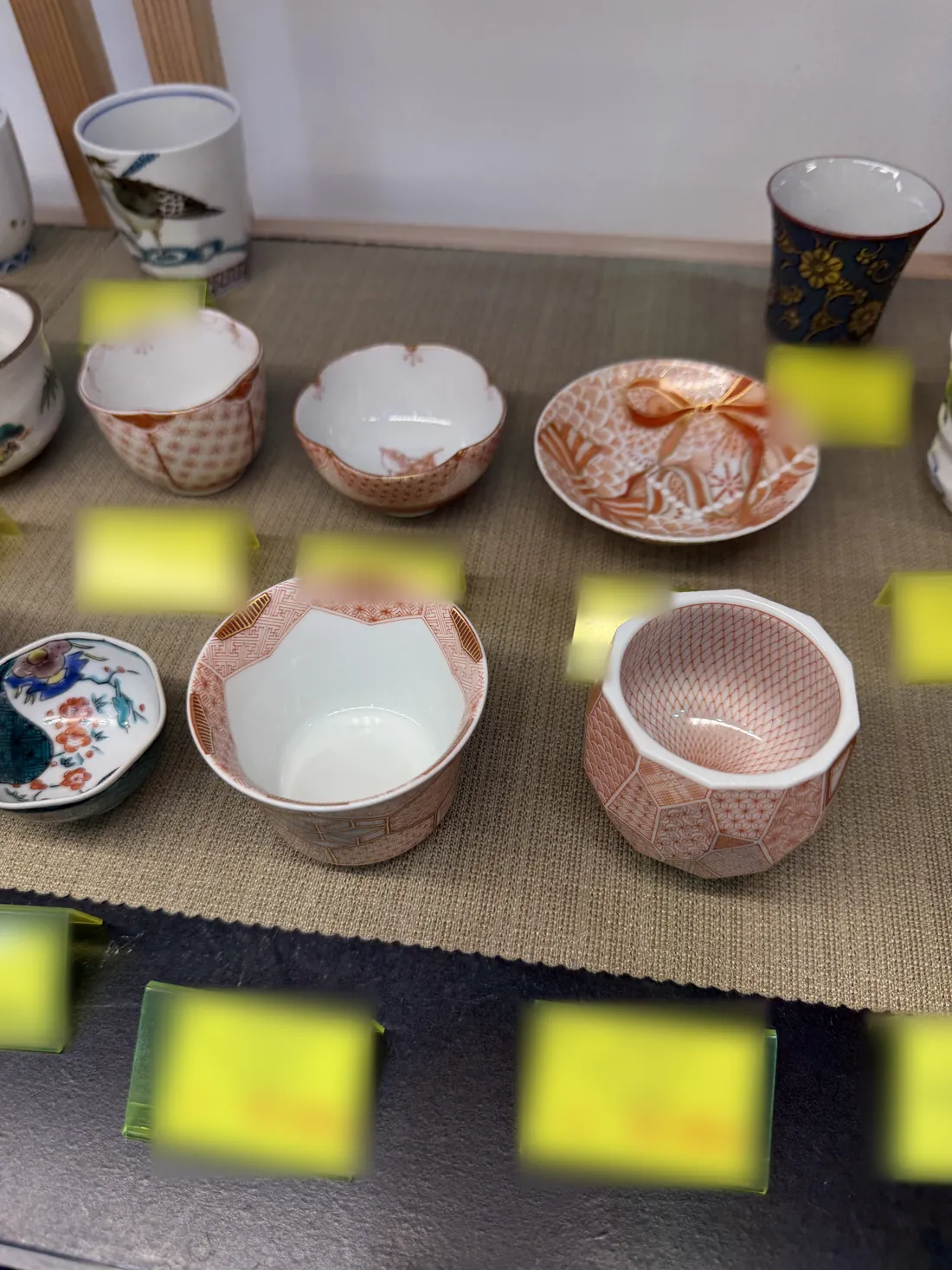
Discovering akae saibyo and Reiko Fukushima
During our conversation about the more expensive red-painted pieces, the staff introduced me to the work of Reiko Fukushima, who, they explained, is the daughter of Buzan Fukushima, a leading figure in Kutani akae saibyo.
I later found her profile on the Isehan Beni Museum’s page for a 2022 exhibition of Buzan Fukushima and his students (in Japanese). After graduating from the Ishikawa Prefectural Kutani Ware Technical Training Institute, she trained under her father. Her awards include the Excellence Award at the 42nd Traditional Kutani Ware Crafts Exhibition (2019) and the Technique Award at the 44th (2021).
Seeing akae saibyo up close — patterns built from remarkably fine red lines — made it clear why some Kutani pieces cost far more than everyday sake cups. They were beyond my budget that day, but an akae sake cup is now on my wish list.
The ¥9,000 purchase
The Shogetsu sakazuki was tagged at ¥11,000 including tax. I had not asked for a discount, but after we had talked for a while about the ceramics and their prices, the staff member offered it to me for ¥9,000. I gladly accepted.
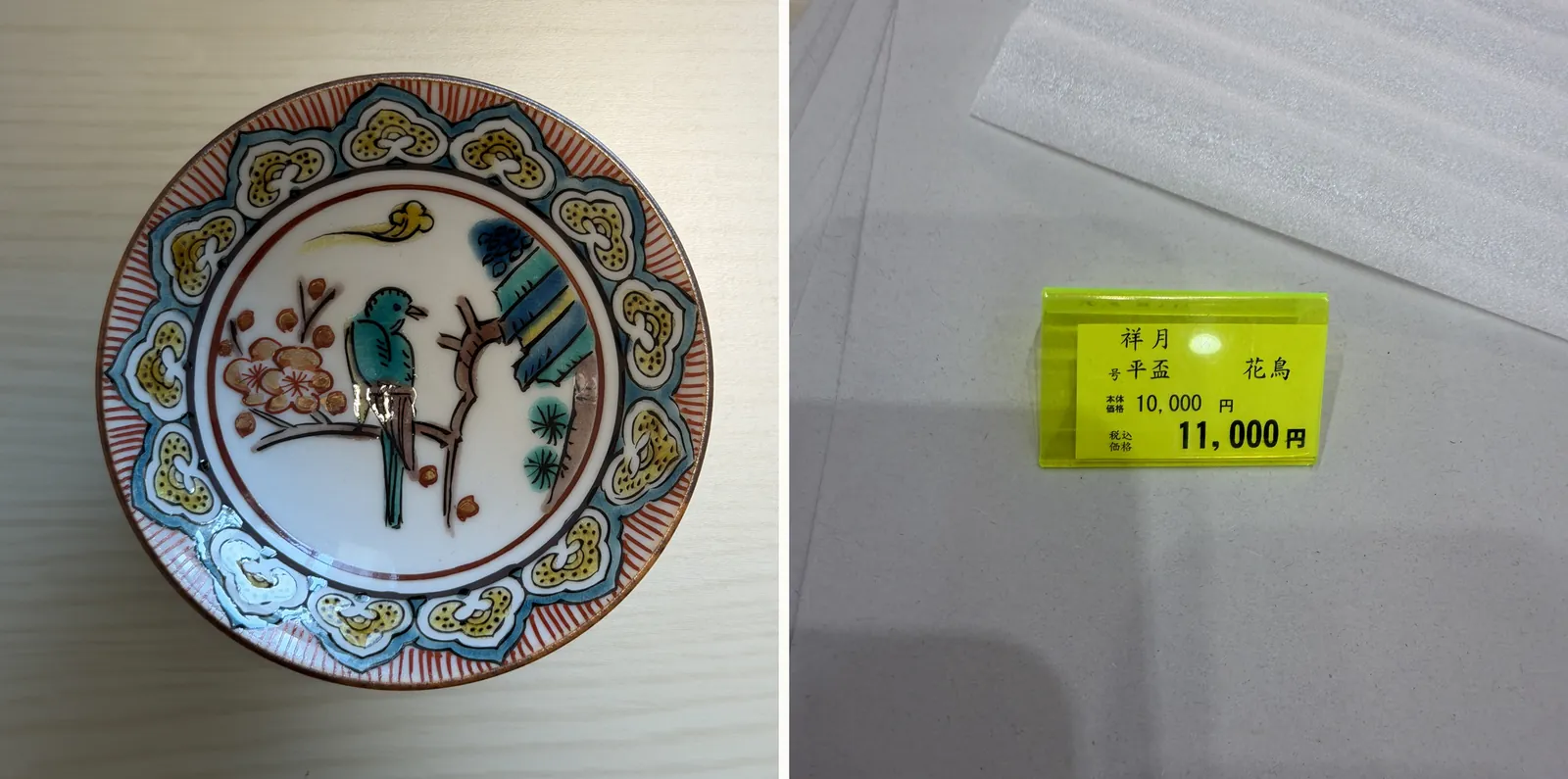
This is what buying at a fair offers that buying online doesn’t: comparing shapes and paintings side by side, asking questions, and discovering artists I hadn’t known. The staff also mentioned that the shop was planning to participate in the 2027 Ceramic and Porcelain Fair in Fukuoka (全国陶磁器フェア in 福岡), scheduled for March 19–23, 2027, at Marine Messe Fukuoka Hall A — another reason to look forward to the next fair.
Drinking Senkin Modern from a Shallow Sakazuki
Back home, I used the cup with Senkin Modern. Until then, most of my tasting had been done with a small glass guinomi or deeper ceramic cups, and the difference was noticeable right away.
At about 8 cm across but only 3.2 cm tall, the cup holds approximately 40 ml when filled to the brim. In everyday use, I find a pour of around 30 ml more practical, leaving enough space to lift the shallow cup without spilling.
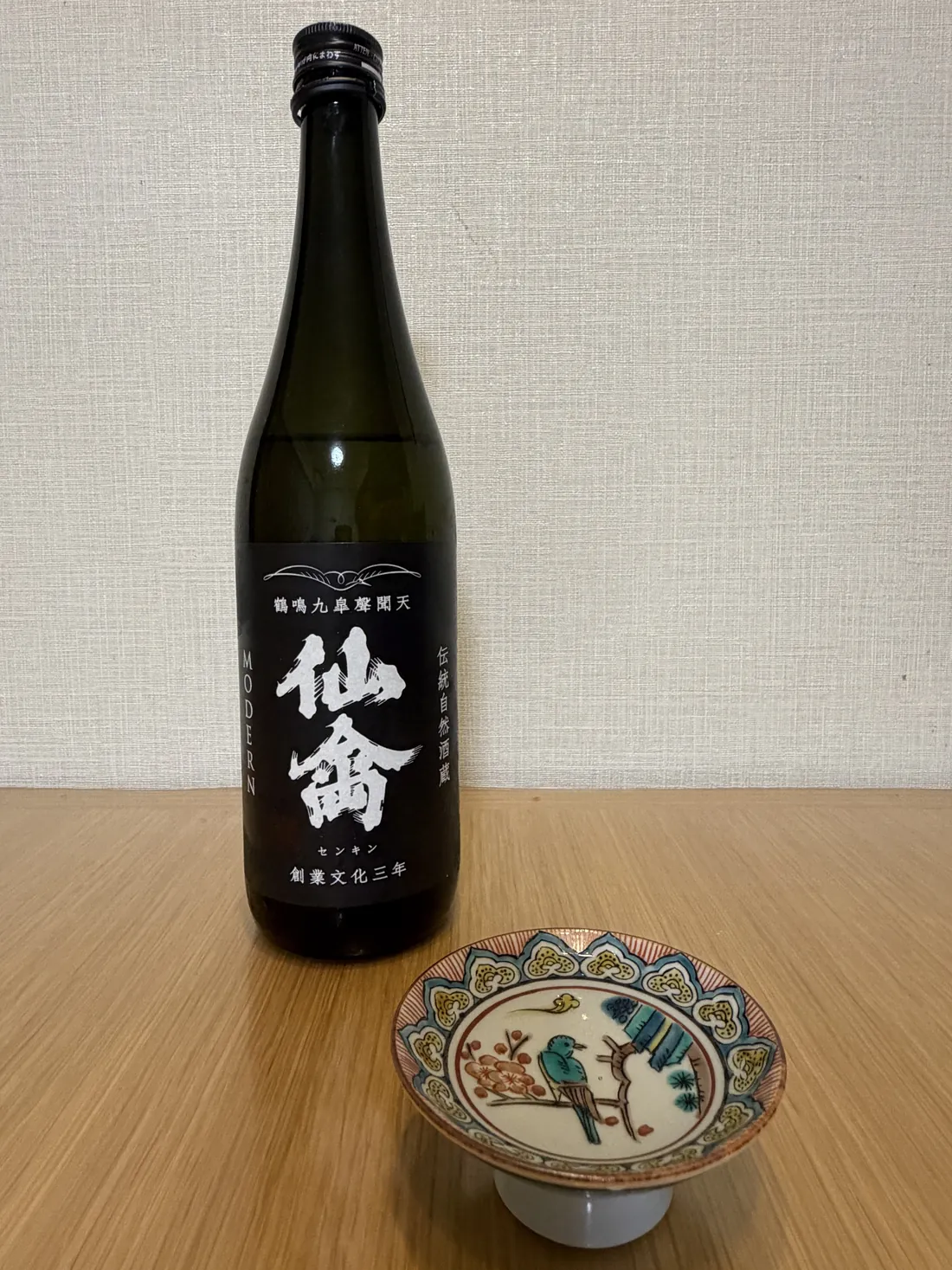
A thin, wide rim
Compared with my deeper glass guinomi, the rim felt thinner at the lips. Because the opening is so wide, it also touched a broader area of my lips, reaching closer to the corners of my mouth.
When I tilted the cup, the sake seemed to spread across my tongue more quickly. Instead of flavors arriving one after another, several impressions seemed to land at once, earlier in each sip. This was my own impression, not a controlled comparison — but it was the clearest difference I noticed.
Does the wide opening affect aroma?
A deeper guinomi keeps more enclosed space above the sake; a shallow sakazuki exposes the surface directly to the air. My guess is that the aroma may feel more open right after pouring, but less concentrated over time. That remains a hypothesis — temperature, pour size, and how close the cup is to the nose could all change the impression. I’d like to test it with the same sake, at the same temperature, in different vessels.
Sakazuki vs. Guinomi: Does the Shape Change the Drinking Experience?
| Kutani sakazuki | Deeper guinomi | |
|---|---|---|
| Rim | Wide, relatively thin | Smaller opening |
| Contact with lips | Felt broader | Felt more concentrated |
| Sake flow | Seemed to spread quickly | Felt more directed |
| Flavor impression | Several sensations at once | More gradual |
| Aroma (hypothesis) | More open to the air | More contained in the cup |
| Visual | Painted interior fully visible | Interior less visible |
These are my impressions with one sake, not universal rules.
Kutani, Oribe, and Bizen Side by Side
| Kutani Sakazuki | Oribe Guinomi | Bizen Guinomi | |
|---|---|---|---|
| Main feature | Painted decoration | Green glaze | Natural firing effects |
| Appearance | Bright, intricate | Deep green | Brown, earthy |
| Surface | Smooth, decorated | Glazed | Relatively rough |
| Shape | Wide and shallow, on a raised foot | Deep and cylindrical | Deep, irregular |
| Price | ¥9,000 | ¥1,100 | ¥3,200 |
| What I notice most | Painting and how sake flows | Glaze and lip feel | Clay texture and firing |
The differences are not only decorative. Each vessel changes which part of the drinking experience catches my attention.
Read my Bizen Ware Guinomi article
Read my Oribe Ware Guinomi article
Practical Notes and Care
A colorful, shallow cup has some limitations.
- Not ideal for judging sake color. The painted interior makes subtle differences in clarity or hue hard to see. For systematic tasting, I still reach for clear glass or a plain white cup.
- Easy to spill if overfilled. The wide, shallow bowl is hard to lift when full, so I keep the pour to around 30 ml.
- Gentle washing. The leaflet that came with the cup advises washing soon after use with ordinary dish soap and a soft sponge or cloth, and avoiding cleansers, nylon scrubbers, and dishwashers, which can damage painted decoration. Rinse well and let it dry completely before storing.
- Protect your table. The leaflet also notes that the foot of Kutani pieces is unglazed, so it recommends a mat when placing them on lacquered or other easily scratched surfaces.
I keep the cup in its wooden box for longer-term storage.
Final Thoughts: Was It Worth ¥9,000?
Judged only as a container for sake, ¥9,000 would be hard to justify. But that’s not why I bought it. I paid for the painting, the surprise of the turquoise underside, the conversation at the booth that introduced me to akae saibyo and Reiko Fukushima — and, as it turned out, a new way of experiencing sake.
I can’t say this cup makes sake objectively taste better. What I can say is that it changed how each sip reached me, and that discovery is exactly why I enjoy exploring Japanese sake ware.
Bizen tells a story of clay and fire. Oribe tells a story of glaze. Kutani tells a story of painting — and this shallow sakazuki adds a story about the shape of the cup itself.
Related Reading
Sake is an alcoholic beverage. This article is intended for readers of legal drinking age in their country — please drink responsibly.